Showing posts with label reports. Show all posts

Monday, April 4, 2016

Grattan Institute fundamentally misunderstand what public transport is for

City living in a world planned by economists

Show me a city planned and built by an economist. Somewhere, this shining example of cost benefit success has transformed peoples lives for the better. All services provided by the government from schools, health, sewage, parks and public transport are run at a profit. I'm sure it exists, outside of the game Simcity or an economists spreadsheet. I just need someone to tell me where it is.

Today the Grattan Institute released its 'Road to Riches: Putting politics ahead of growth' report. It attacks the Capital Metro light rail project and makes two claims on its second page that don't bear scrutiny: "Canberra’s light rail, now being built, is likely to provide no more benefits than bus rapid transit but cost more than twice as much.". The environmental, societal and economic benefits of light rail are well proven, and LRT will not cost twice as much. The basis of the Grattan Institute claim is faulty.

In its 'Case Study' on page 42 The author adopts the classic economist strategy of ignoring the benefits that make a transport project beneficial, to prove somehow that it 'costs' money. Even worse than blind ideology is wilful dismissal of evidence that doesn't conform to the authors chosen agenda.


Complete text of Grattan Institutes analysis

The missing data that the Grattan Institute choose to ignore to 'prove' their case is the April 2012 report by URS called 'City to Gungahlin Transit Corridor: concept Design Report'. Page 13 of this report breaks down the costs of BRT and LRT. The problem with this breakdown is an assumption that no buses will need to be purchased. In the costs table under 'Vehicles and Depots', the BRT column has no figure. None at all. Will a directly comparable BRT system require no new vehicles or infrastructure? Of course not.

If there are no new vehicles being purchased, then where is this 360 million dollars going? It isn't adding capacity to Canberras public transport network. It is building roads. Effectively, we would be spending (not investing) 360 million dollars for zero return. We get no extra public transport capacity whatsoever. Half the cost of light rail with no benefit at all.


The first stage of Capital Metro will procure 14 light rail vehicles. Each vehicle has a passenger capacity of 220. If ACTION ran articulated buses (with a 100 passenger capacity) solely on this route under a BRT model, they would need to purchase at least 30 new buses. At 800,000 dollars per articulated bus, that is a minimum of 24 million dollars of new buses, and several million more for depot facilities. It is a well known transport fact that light rail vehicles are cheaper over the longer term because although more expensive upfront, they are in service decades longer than a bus, and have far less costs to service and maintain.

URS understand this. Even factoring in a fictional cost of zero for thirty new buses, they conclude on page 54 that:
"The estimated capital costs for these two options are $300 – $360 million for BRT and $700 – $860 million for LRT. The higher LRT capital cost is attributed to additional costs such as track, electrical, a new LRT depot, and new light rail vehicles. Additional costs for LRT also come from the larger and more complex stops/stations required. A triple bottom line evaluation undertaken of these options, comparing their social, economic and environmental impacts to the ‘do-nothing’ scenario has shown LRT to provide higher benefits due to its higher social benefits."

Concluding on page 55:
"Overall the study shows that there are significant opportunities to improve the corridor with the implementation of either BRT or LRT, and potentially additional benefits if the corridor were to be extended in the future.
BRT is a cost-effective option, whilst LRT generates the best overall outcome for Canberra."

The full Capital Metro business case from October 2014 also provides evidence that light rail will provide a positive economic return of 1.2. This business case is also ignored by the Grattan Instiute. The author selectively quotes a figure from an earlier report that conforms with the aim of their study, ignoring a later report that does not. I'm not sure how reliable and trustworthy analysis can be when confirmation bias by the author excludes evidence disproving primary contentions of the authors hypothesis.

The Grattan Institute fundamentally misunderstand what public transport is meant to do for society. It does not always exist to make a profit (although it is always great when it does), but it does exist to provide a service to the public. We pay taxes and rates so that the government will aggregate our common wealth and provide services that provide a public benefit. Healthcare, education, painting lines on roads. All sorts of services that would never return a profit, or would even be performed unless we paid for it through governments we elect and fund.

Capital Metro Stage One is a public transport solution for Gungahlin residents, a first stage for an all of Canberra future transport technology (as we grow we will need it), a catalyst for urban renewal, a catalyst to redevelop Northbourne Avenue into a worthy entrance to our Nations Capital, and a long term economic productivity booster. Not just through the immediate job creation though construction, but the longer term economic activity that Transit Oriented Development is proven to attract.

In politics making decisions for the future is the hardest task. Short sighted populist decisions are easy, making the hard ones, making the tough calls for a better future is a risk. In 2012 the ACT Government took that risk and chose the best overall outcome for Canberra by going to an election with light rail for Canberra as a policy. They were returned for another term by the electorate and are implementing the long term plans that will benefit Canberra for decades.

For more frequent updates on Capital Metro and light rail related news,
 please visit our Facebook page 'Light Rail for Canberra'. 


Monday, June 22, 2015

Light rail draft environmental impact statement released

Front page of 1600 page report

The ACT Government has released a mammoth 1600 page draft environmental impact statement on the Capital Metro light rail between Gungahlin and Civic. It is a comprehensive examination of the impact that light rail will have along the corridor and covers many different areas.

You can download the full report here.

The ABC has covered the report here. It leads with its most obvious concern 'Canberras light rail poses significant risks to appearance of Northbourne Avenue, report says'

The Canberra Times has two reports - one quite informative and balanced here, and another focussed on the negative aspects here. The second talks up the minimal savings in time that drivers will experience as a result of having mass transit as an alternative option, and also the loss of a car park (that is scheduled to be sold anyway).

It does have a useful breakdown of key facts:

Construction
  • Construction depots take over London Circuit carpark near the courts; site of visitor information centre on Northbourne Avenue, carpark opposite Exhibition Park.
  • About 60 truck journeys a day in 2017 and 2018 (36,000 movements across the two years); 7800 truck movements in 2016.
  • Standard construction hours 7am till 6pm Monday to Saturday; major intersection work, overhead wiring and oversize deliveries done outside standard hours.
  • Construction to use 74,000 cubic metres of concrete, 3.4 million litres of diesel, 9500 tonnes of asphalt, 100,000 metres of PVC ducts, 3000 tonnes of steel for rails, plus 9300 more for reinforcement and structural work.860 trees removed.
  • Construction to employ an average 500 people, up to 900 at peak times.
  • Weekend closure of key Northbourne intersections at Macarthur/Wakefield; Mouat/Antill; Barry Drive/Cooyong; Alinga (closed Friday 10pm til Monday 4am, adjacent ones not on the same weekends). Other intersections to be "sporadically closed" for up to two or four weeks, with diversions. Bus routes using the corridor and running across the corridor periodically disrupted.
Operation
  • Light rail vehicles operate Monday-Thursday 6am-midnight, Friday-Saturday 6am-1.30am; Sundays 8am midnight. Light rail vehicles every six minutes at rush hour, every 10 minutes 9am-4pm, every 15 minutes other times. Journey time 25 minutes Gungahlin to the city. 14 Light rail vehicles, each up to 33 metres long, with dedicated space for four bicycles. Top speed 70kmh.
  • Platform at each stop 33 metres long, capable of extension to 45 metres for extended vehicles; signalled pedestrian crossings to nearest footpath. Light rail corridor 7 metres wide, widening in places to 10.4 metres, including outbound and inbound Light rail lanes and median strip.
  • Light rail replaces trunk and express bus routes on Northbourne Avenue, the Federal Highway and Flemington Road.
  • An extra southbound lane to be built from the Barton Highway to Antill Street, 630 metres long.
  • Road changes include banning of turning across the median in some locations, including: Exhibition Park entrance, the Kamberra Wine Company on Flemington, the Yowan Golf Club on the Federal Highway, the netball centre on the Federal Highway, the southbound right turn from Northbourne Avenue to Bunda Street.
  • Seven electricity substations to be built along the route, each in a 12m x 4.5m building, at: Gungahlin depot, Flemington Road, Collaroy Street, Vicars Street, Barton Highway, Macarthur House and Mort Street.
This draft EIS is a very useful document, It informs the likely disruption that construction will cause, and enables businesses along the route to plan accordingly. With the Majura Parkway almost complete, much truck traffic will have shifted off Northbourne already.

It also looks at issues such as the lack of familiarity that local drivers and pedestrians have with large light rail vehicles rumbling along, and proposes an education campaign to familiarise Canberrans with their new transport infrastructure.

The CT reports that:

Health and socio-economic impacts form part of 17 broad topics discussed in the environmental impact statement.
The report is designed to identify "worst case scenarios" to mitigate potential problems before construction of the proposed stage one development of the 12-kilometre tram route between Gungahlin and the city.
The document says key issues were impacts to heritage, noise and vibration, planted trees, landscape and visual, traffic and transport, social and economic, and property and land use.
The EIS also sets out problems and mitigation strategies for biodiversity, air quality, contamination and soils, utilities and services, hazard and risk and bushfire, among others.
The 1700-plus page report, put together by Parsons Brinckerhoff with ACT government data, has been in the works since last October.

The ABC ran the following story on 20 June 2015


A public consultation period is now open with several public sessions planned to gather feedback and provide further information.

For more frequent updates on Capital Metro and light rail related news, please visit our Facebook page 'Light Rail for Canberra'.  

Wednesday, April 29, 2015

Updates to ACT Transport studies page


Image from Canberra Airport Light Rail plan
Over the course of time, many reports on Canberra's transport needs have been created. We live in a planned city, and planners conduct research and publish it. 

On this page are links to resources and ACT transport studies for you to read and form your own opinion about the best form of mass transit public transport system for the ACT.

If you are aware of any resources or studies we do not have listed, please email us with that information and we will update the page. If a link is dead - try the Internet Archive.

We hold paper copies of other reports, but do not have the ability to convert these large reports to PDF at this stage.

For more frequent updates on Capital Metro and light rail related news, please visit our Facebook page 'Light Rail for Canberra'.  

Saturday, April 18, 2015

1989 Gungahlin External Transport Study

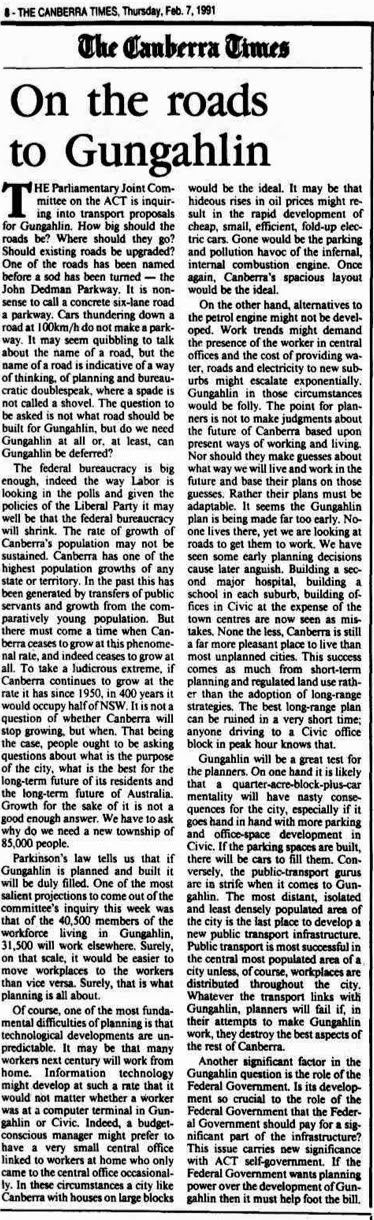
In 1989 the Gungahlin External Transport Study (GETS) was undertaken. It was meant to assess future transport needs for Gungahlin residents - before Gungahlin had even been mapped out or a single new home constructed. These articles are from the Canberra Times and can be found online at Trove.

ACT Light Rail have a copy of the resulting report, but it is in hard copy and yet to be scanned.


Following the GETS study Gungahlin ended up with inadequate roads and finally in 2012 a light rail proposal. This 1991 CT article is quite prescient.

For more frequent updates on Capital Metro and light rail related news, please visit our Facebook page 'Light Rail for Canberra'.  

Monday, November 17, 2014

A review of Canberra traffic from 1962


This 1962 traffic survey of Canberra has just been located. It is a fascinating insight into the future that transport professionals saw, at that time, over 50 years ago. 


W. Morison
B.E., Dip.T.P., Traffic Engineer, National Capital Development Commission, Canberra

paper No. 46

"It outlines the 1961 population and employment structure and vehicle ownership of Canberra before briefly describing a comprehensive origin destination survey conducted in 1961 as the first stage of a transportation study and report for the National Capital.
Total trip generation is discussed for Canberra as well as for some suburbs more closely studied. Generated traffic is related to population all day employment; 1961 parking generation also is related to floor space all day employment. The paper discusses some of the future implications of Canberra's expansion, its road planning and traffic needs, and concludes by noting the possibility of some pure research projects being based on the 1961 origin-destination survey."


For more frequent updates on Capital Metro and light rail related news, please visit our Facebook page 'Light Rail for Canberra'.  

Tuesday, November 4, 2014

Operational cost of light rail in Canberra - around $22 million a year


Canberra currently spends around $110 million a year to operate ACTION Buses. The operational cost of light rail has been the subject of much speculation. The Capital Metro Business Case informs us that the estimated cost of this is $22 million a year. 

For more frequent updates on Capital Metro and light rail related news, please visit our Facebook page 'Light Rail for Canberra'.  

Friday, July 18, 2014

Gaps in Transit Review - riposte to sloppy analysis from a CT reader


An excellent riposte to the sometimes misleading and sloppy analysis on light rail costs and benefits, published recently in the Canberra Times, in a letter from a reader. This letter is in the 'Letters to the Editor' page of the July 18 edition of the Canberra Times, and also online.

Gaps in transit review


I write as an outsider but frequent visitor to Canberra. I think the heading in your article ''Light rail poor value: report'' (July 15, p1) was misleading.

The Productivity Commission has criticised the process of moving to a go-ahead for Capital Metro from the point reached in a submission to Infrastructure Australia in 2012.
That does not necessarily imply they conclude the project is of doubtful validity. I sense they are instead criticising a gap in the decision-making logic without actually having the data to finally judge the project options. The submission in 2012 for preliminary funding showed better benefit-cost ratios for Bus Rapid Transit options than Light Rail Transit Options because of the lower capital cost of the former.

However, the two types of projects would not be equal on other grounds, and I think this is where the gap in economic and business cases has not been filled (at least in terms of public disclosure). Light rail will be better for value capture in relation to property development, based on overseas experience. The economic benefits of densification along transport corridors, and so-called agglomeration productivity benefits, are areas where our local experience in cost-benefit analysis is perhaps at the learning stage, but that is not to say that one cannot judge that they will be valuable.

In addition to the projected fare revenue and the lower operating costs of trams versus buses, I understand the ACT government had previously pointed to car parking revenues and this relatively new area of ''value capture'' as two key prospective financial benefits.
No one has yet done justice to analysing these factors in a publicly available study. The Nairn report for the ACT Liberals, which claimed the Capital Metro project would be unviable, seems to me to have a few major holes in terms of financial analysis. A long-term project was evaluated over less than its effective economic life, using 100 per cent debt funding paid off over 15 years, but assuming that the project was worthless after repaying the debt.

To assume a project is worthless in 15 years' (or even 30 years') time would necessarily pre-condition the result of such an analysis and make it a misleading exercise. And that is not to criticise Bob Nairn's transportation knowledge - it just says that the financial analysis (as distinct from his analysis of the transport issues) could not have been complete and must, to that extent, be unsound. I can't tell how this might have affected the end result, as I don't have all the data.

However, Mr Nairn's table of figures seems to project a stabilised fare revenue of only $2.2 million per annum. Simple arithmetic says that at an average light-rail trip fare of circa $4.50, this revenue estimate implies only about 1300 paying passengers per day, or six to seven full vehicles. Unless I am misinterpreting his analysis, that seems ridiculously low and would be a second doubtful element in terms of reaching a sound conclusion as to project viability.

I hope I am not being too unfair to Mr Nairn, but what I read didn't convince me that we have the full picture as yet. And, as a visitor, I cannot understand why the parliamentary and government offices area south of the bridge would not be a viable future route.
It is not just locals one should provide for, because if Canberra Airport goes international, future tourism potential is another major beneficial factor.

Ian F. Bell, Sydney, NSW

For more frequent updates on Capital Metro and light rail related news, please visit our Facebook page 'Light Rail for Canberra'.  

Thursday, June 12, 2014

Canberra Liberals commission a report on Capital Metro and agree with themselves again


In their ongoing campaign to prevent the ACT Government from improving
Canberra's public transport infrastructure, the Canberra Liberals have
commissioned a report on the Capital Metro light rail. To the surprise
of all, the report has concluded that the cost is higher than the
government expects, that the benefits are less then the governments
claims and that disturbingly, the project is not 'economically
viable'.
Mr Bob Nairn, a retired transport consultant, was commissioned by the
Canberra Liberals to perform this research.  Without access to the
report, ACT Light Rail can only comment on what the media has selected
to use in its reporting.

The first thing that strikes us as odd, is that the costings are based
on US figures. There is ample contemporary light rail construction and
vehicle procurement locally, that Australian figures and costs from
Gold Coast, Adelaide or Perth could easily have been obtained. So why
have the Canberra Liberals and Mr Nairn used US figures?  This is
puzzling, especially as Mr Nairn has experience consulting to
Australian light rail projects.

The report also ignores information already in the public domain. For
example, it is expected that the Myway card will be used on light rail
and the bus, and that the entire trip will be capped (as it is under
the existing ACTION only system). This impacts the liberal
calculations.

Indeed, this is the trip model being moved to all around Australia,
where all public transport networks are being increasingly integrated
in contemporary public transport networks.

The effect on ACTION services that the Liberal report suggests, also
ignores the reallocation of ACTION buses following the commencement of
light rail service. ACTION buses will be taken off the red rapid run
from Gungahlin to Civic and re-tasked to better serve Gungahlin
suburbs, and to feed greater numbers of passengers to the light rail.

Services adjacent to Northbourne avenue will also be expanded. This
planning is already underway by ACTION, in conjunction with Capital
Metro. The government expects more passengers to use the bus service,
as well as Capital Metro, and is planning accordingly. ACTION will be
buying more buses, not less, as the Liberal report would suggest.

Contrary to the liberal report, contemporary Australian experience
shows a rapid uptake of light rail patronage, exceeding the bus
services they replace. Mr Nairn has not taken this into account.

Sadly, the Canberra liberals fail to understand what makes a public
transport system viable. The best way to make a public transport
system viable is to attract as many full fare paying adult passengers
as possible. They will not use the bus, as bus patronage has been in
decline for years. A viable system, is one that carries passengers,
not empty buses.

It took the ALP government twelve years of bus improvement programs
before they realised that Canberra had outgrown a bus-only solution,
and needed a better mass transit technology. Light rail is the
technology to meet Canberra's existing public transport problems and
ensure that a scalable solution is in place for Canberra future. This
is the policy that was put to Canberra's voters in 2012, and which
they supported.

Unfortunately, the time and money that the Canberra Liberals could
have used to develop an alternative public transport policy, has been
spent on attacking a project that was supported by the electorate at
the last election - a light rail and integrated bus public transport
network. The public deserve better than a constant attack, they
deserve an alternative approach.

For more frequent updates on Capital Metro and light rail related news, please visit our Facebook page 'Light Rail for Canberra'.  

Tuesday, October 30, 2012

ACTION bus patronage continues to decline

In disappointing news, figures released today from the Australian Bureau of Statistics indicate that ACTION Bus patronage continues to decline. These figures are from the 2011 Census and are the most recent and reliable figures available.

Read: New 2011 Census data reveals more about the ACT 

An excerpt from the media release states:


Method of travel to work

The latest Census data further revealed that people in the Australian Capital Territory still prefer to travel to work by car than any other means, with 69.3 per cent of the population reporting this as their primary method of travel to work (either as the driver or passenger). 

While the household car is still the preferred method of travel to work for most people, there is an increasing proportion of people walking and riding a bicycle to work. In 2011, 763 more people walked to work than in 2006, and 914 more people rode a bicycle to work.

There has been a small decline in the proportion of people who catch a bus to work, with 5.6 per cent of people in 2011 compared to 5.8 per cent in 2006, reflecting a slower rate of growth compared to other methods of travel.


While there is a rise in walking and cycling, these ABS statistics indicate that unless an alternative to the private car is provided, public transport patronage will continue to decline. 

Light rail will offer that alternative. Build light rail now!


Saturday, June 16, 2012

Molonglo residents moving in - prepare for decades of road congestion

Last week the Canberra Times carried a story on residents preparing to move into the new residential developments in Molonglo. I think It is important to note that there is no adequate public transport infrastructure ready to cater for these residents. ACTION Buses have released 'network 2012' and no Molonglo routes are mentioned. The 'Network 2012 route map' does not even show Molonglo. A massive public transport failure. 

This ACT Government planning failure dooms Molonglo residents to having to use cars to travel around Canberra. It means that a family MUST have two cars or be socially isolated. it means that commuters have no choice but to drive to work. 

Affordable housing is not so affordable when the costs of an extra car are added to the family budget. The NRMA estimate this extra cost to be a minimum of ten thousand dollars a year. 

ACT Light Rail made a submission in 2007 recommending that prior to residents moving in, that  light rail be built between Molonglo and Civic, or Molonglo, Weston Creek, Woden and Civic. This would ensure that the decades of lost productivity, road congestion and bickering over access would not be repeated. 

It of course, did not occur. The ACT Government are road focussed and the NCA really have no power over such a decision. 

Ironically, even though the ACT Government love building roads, they always skimp on that building with a single lane road one year, a dual lane road a few years later, then a dual carriageway ten years on, then after another five or so years a dual carriageway with an extra lane added, which they will then come along and mark oddly to cater for recumbent bicycle fanciers. Pleasing no one, and tripling the cost of the road construction. I present Flemington Road and Gungahlin Drive as prime examples of this bizarre enthusiasm.  

The NCA and ACT Governments own reports on Molonglo development already pointed out that road access into and out of the new development would experience road congestion. Each of the future projections indicated more and more roads would need to be built and expanded. There was no mention of BRT or LRT. ACT Light Rail proposed light rail and a design that favoured public transport access.  

This was the finding of the NCA in May 2008, on these issues:

Report on Consultation National Capital Plan Draft Amendment 63 – Molonglo and North Weston National Capital Authority 


1.17 Transport and Traffic 

Issues 
Twelve (12) submissions raised issues with planning for sustainable transport infrastructure and implications of new urban development on existing roads. 
A number of submissions raised concern that relevant traffic studies and modelling have not been undertaken, or objected to traffic flow projections produced in the Preliminary Assessment. It was generally established that integrated transport planning needs to be given a high priority, and that any sustainability scenario would envisage a greater provision for public transport initiatives. 
Of note were those submissions that advocated the need to investigate light rail as an alternative to buses for public transport, and to increase public transport patronage. These submissions noted that the existing public transport system in Canberra does not cope with demands placed on it, and is not attractive in its current form and service level. 
Suggestions included a light rail link from Molonglo to Woden and/or Civic to aid in reducing congestion on roads; reducing travel times; and providing an opportunity to increase density along major public transport routes. 
A number of submissions commented on the potential pressures that may be placed on existing roads with the increase in population, and noted the need to upgrade existing major roads such as Cotter Road and Lady Denman Drive. It was noted that Tuggeranong Parkway needs to remain the major transport connection between Molonglo and Woden. 
NCA Consideration 
The detailed design, including the provision of services and infrastructure is the responsibility of the ACT Government, including the investigation and development of transport infrastructure throughout the Molonglo and North Weston area. DA63 identifies a proposed Inter-Town Public Transport Route, however this is only indicative. In this case it aligns with options presented in DV281 and the Preliminary Assessment. 
The indicative route does not specify the mode of transport, and therefore does not preclude light rail. The mode of transport will be determined by the ACT Government. 
Light rail as a public transport option has not been investigated significantly by the ACT Government for the Molonglo and North Weston development. Instead, development of the area is considered an opportunity to expand and strengthen the inter-town bus network by creating an orbital system in additional to the existing line haul system. 
Recommended Changes 
No change. 

Wednesday, June 13, 2012

Gungahlin's transport links : a report from 1991

ACT Light Rail have been asked to speak at the Gungahlin Community Council public forum tonight. This seems to be an opportune time to post the executive summary from the 1991 report into Gungahlin transport requirements.

Gungahlin's transport links : a report of the Parliamentary Joint Committee on the Australian Capital Territory

Recommendations: 
1. (a) bus services be introduced into Gungahlin as soon as the first neighbourhoods are occupied; 
(b) intertown express services be introduced between Gungahlin and Belconnen, and Gungahlin and Civic as soon as demand exists; 
(c) a conveniently located bus interchange be established in Gungahlin at the first opportunity; and 
(d) a detailed strategy of measures to encourage the use of public transport and other non-car modes of transport, such as those described in paragraph 3.4, be developed and implemented as soon as Gungahlin's first neighbourhoods are occupied; 

2. (a) the NCPA and the ACT Planning Authority jointly commission or conduct a study into the establishment of a rapid transport system in the Australian Capital Territory. 
(b) to maximise the potential advantages of a new technology rapid transport system, including the possibility of reducing the need for additional road space to cater for the travel needs of the future residents of Gungahlin, this study should be completed and its findings released before the Commonwealth and Territory Governments commit themselves to the construction of any new roads to or from Gungahlin; and 
(c) in the interim a reservation be made between Civic and Gungahlin to allow for the construction of a rapid transport system; 

3. (a) the Commonwealth and Territory Governments jointly and separately (where appropriate) develop and implement the measures described in paragraph 4.4 - such as limiting employment growth in Civic - to limit the number of vehicles travelling between Gungahlin and Civic or other southern destinations; and. 
(b) the Commonwealth Government's log term strategy for office location be amended to give priority to the development of additional office space in Gungahlin as well as in Tuggeranong and Belconnen; 

4. William Slim Drive between the Barton Highway and Ginninderra Drive be upgraded; 

5. (a) provision not be made in the National Capital Plan for a John Dedman East road; and 
(b) the Bruce Ridge - O'Connor Hills area be given legislative protection to preserve its ecological, recreational and educational values; 

6. (a) a detailed environmental impact assessment be made of the John Dedman Community Option and John Dedman West alignments; 
(b) in conjunction with the assessment, a broader study of the present and future parking and traffic management needs in the area of the AIS be conducted jointly by the ACT Planning Authority and the NCPA. 

7. (a) provision be made in the National Capital Plan for a Majura Parkway; 
(b) a detailed alignment study be conducted to minimise any impact on existing leases in the Majura Valley, for example by following the line of the existing Majura Lane; 
(c) a detailed environmental impact assessment of the Parkway be made; 
(d) the ACT Governnment investigate the immediate introduction of noise abatement measures along Fairbairn Avenue; 

8. (a) Monash Drive not be constructed. However the road reservation should be retained in the National Capital Plan until it is clear that a severe disruption to the amenity of North Canberra can be avoided by the increased use of public transport and by the effective operation of the peripheral roads; and 
(b) the Mount Majura - Mount Ainslie area be given legislative protection to preserve its ecological, recreational and educational values. 

9. (a) the proposed extension to Ginninderra Drive not proceed but that, to minimise the level of through traffic in Lyneham and O'Connor, Mouat Street be widened and traffic management and calming techniques be introduced in the area; 
(b) the implementation of these measures not be deferred until the expected increase in traffic from Gungahlin occurs, but commence immediately so that the already high levels of through traffic are reduced; and 
(c) the ACT Planning Authority conduct a comprehensive study of all North Canberra suburbs to identify particular streets that warrant the introduction of traffic management and calming techniques; 

9. (a) the joint NCPA and ACT Planning Authority study of the area south of Mitchell and between the Federal and Barton Highways commence immediately, and. 
(b) the study assess the usefulness of a highway link road and determine a road alignment which would effectively link the two highways with the Majura Valley corridor so as to encourage commercial and other through traffic to divert to the peripheral arterial roads and by-pass North Canberra.

Wednesday, June 22, 2011

Greens Paper - A Better Transport Solution for Gungahlin and Wider Canberra.


The ACT Greens today published a very well researched and balanced paper examining the different modes of transport available to Canberra residents. The paper looks at roads, cars, buses and light rail - and recommends light rail and integrated bus services as the best solution for (initially Gungahlin) residents.  The paper can be downloaded here. 

The paper uses the ACT Governments own reports and research in proving the business case for light rail and/or bus rapid transit. It lists the benefits and disadvantages of both modes, and recommends light rail. The initial route that the Greens propose is from Gungahlin to Civic, with extensions to Barton via Russell. 
Greens proposed light rail route from Gungahlin to Civic/Barton/Russell

In looking at the various transport modes, there is also a look at the requirement to continuously build parkway style roads in Canberra. The current debate concerning the 400 million cost of the Majura Parkway is examined. This road certainly needs upgrading, but not to Parkway standards. The paper recommends some sensible upgrades to Majura road and identifies where this funding could come from.

Naturally being the product of a very robust political debate underway right now, it is critical of the Labor governments approach to transport. Some quotes from the Greens MLA Amanda Bresnan illustrate the difference in opinion on what sustainable transport consists of.

“The ACT Greens want to see real transport solutions – solutions that will create convenient, sustainable and equitable ways to get around Canberra,” Ms Bresnan said.
“We are arguing for investment in and prioritisation of a rapid, high capacity public transport network. This is the long term solution for bringing convenient, effective and sustainable transport to North Canberra.
“It is troubling that the Government’s arguments for building the Majura freeway are not standing up to scrutiny. The Government hasn’t assessed issues such as the benefits that quality public transport would have compared to a freeway. Nor has it properly assessed future traffic congestion on the road, the greenhouse gas emissions it will generate, or the impacts on Canberra’s urban form.

"In Australia and around the world, the lesson to learn from the evidence presented by planning experts is that good public transport is the best way to tackle congestion." Ms Bresnan said. 
Regardless of where you stand on the political spectrum, the research in the Greens paper is supported by evidence. Indeed much of that evidence comes from the ACT Government own research - and is not new to those following the light rail debate.  It will be interesting to see what sort of run this paper gets from the media.